| The West Highland Way |
By Mark Walford
Day Six
Route: Kinlochleven to Fort William
Distance: 14m (22.5km)
Elevation: 30ft (9m) to 1,076ft (328m)
Climbing (ascent and descent): 2,188ft (667m) and 2,192ft (668m)
 Prev
Next
Prev
Next

|
See Route on ......
This place ain't so bad after all ....
The final morning of our walk arrived in a blaze of unapologetic sunshine, as if Scotland, having spent the better part of a week testing our resolve with rain, mud, and moral doubt, had decided at the last possible moment to show off what it could really do when in a good mood. It felt faintly miraculous that we had covered close to a hundred miles since that optimistic photograph in Kelvingrove Park, and even more miraculous that I had survived the experience with all limbs attached and functioning, albeit with the occasional complaint.
My legs, which had spent much of their existence draped indolently across sofas, had at last accepted their new vocational direction and were performing with something approaching competence. There was still the usual morning stiffness, a sort of creaking protest at being brought back into service, but once warmed up they carried me along with a grudging reliability. My toes, meanwhile, had settled into their final form—bruised, discoloured, and deeply unimpressed—but all ten toenails remained stubbornly in place, much to the disappointment of whoever had taken part in the apparent family sweepstake. The chafing, both in polite and impolite regions, had retreated under sustained bombardment from Sudocrem. In short, I felt excellent. Externally I may have resembled a shop soiled vagrant with a fondness for gaiters, but internally I was a cherub.
Breakfast was accompanied by an unexpected sideshow as our host stalked and dispatched wasps with the calm efficiency of a man who had made peace with violence. I can’t recall exactly what the “special” consisted of, but I do remember it involved bacon, cheese, and tomato layered in a manner that suggested both ambition and confidence, and it was absolutely superb.
On our way to meet Kath we paused at the local Spar, that dependable bastion of rural civilisation, to stock up on lunch. As we browsed the shelves a woman lamented the absence of crisps with the kind of theatrical despair usually reserved for national tragedies.
“Och… nay cheese an’ onion
crisps!”
We felt her pain.
Kath was waiting outside the Tailrace Inn, and I took the opportunity to record a final morning entry for the video diary.
In the gentle light of early day,
Kinlochleven,
had softened considerably. The same buildings were there, the same brooding presence of the old aluminium plant dreamed its dark dreams, the same enclosing ring of mountains frowned down—but now it all seemed… forgivable. Perhaps even likeable. Of course, it helped enormously that I was leaving.
... but getting out of it is
If Kinlochleven had decided to redeem itself aesthetically, it made no such concessions physically. The climb out of town was a long, unrelenting pull, steep in places and punctuated by those infernal wooden steps that appear to have been designed by someone with either extraordinarily long legs or a deep personal vendetta against walkers. Each step demanded either a heroic lunge worthy of an Olympic hurdler or a series of awkward little hops like an indecisive sparrow. I fell into my usual pattern—falling behind, stopping frequently, muttering darkly, and promising vague improvements to my future self who, I strongly suspected, would ignore me completely. It was, however, undeniably beautiful. The path wound through the Mamore Forest, shafts of sunlight filtering through the trees, and every so often the view opened out behind us to reveal
Loch Linnhe
stretching away in silvery calm. Walkers passed me regularly—fresh, clean, and irritatingly energetic—and I resisted the urge to shout after them that I had walked all the way from Glasgow, which I felt should entitle me to some form of public respect, if not a small parade.
Eventually I hauled myself over the final crest to find Colin filming and Kath looking annoyingly composed. We gathered ourselves, took in the sweeping mountain views, and set off once more—this time with the comforting knowledge that the worst of the climbing was behind us.
|
|
|
General Wade's military road
|
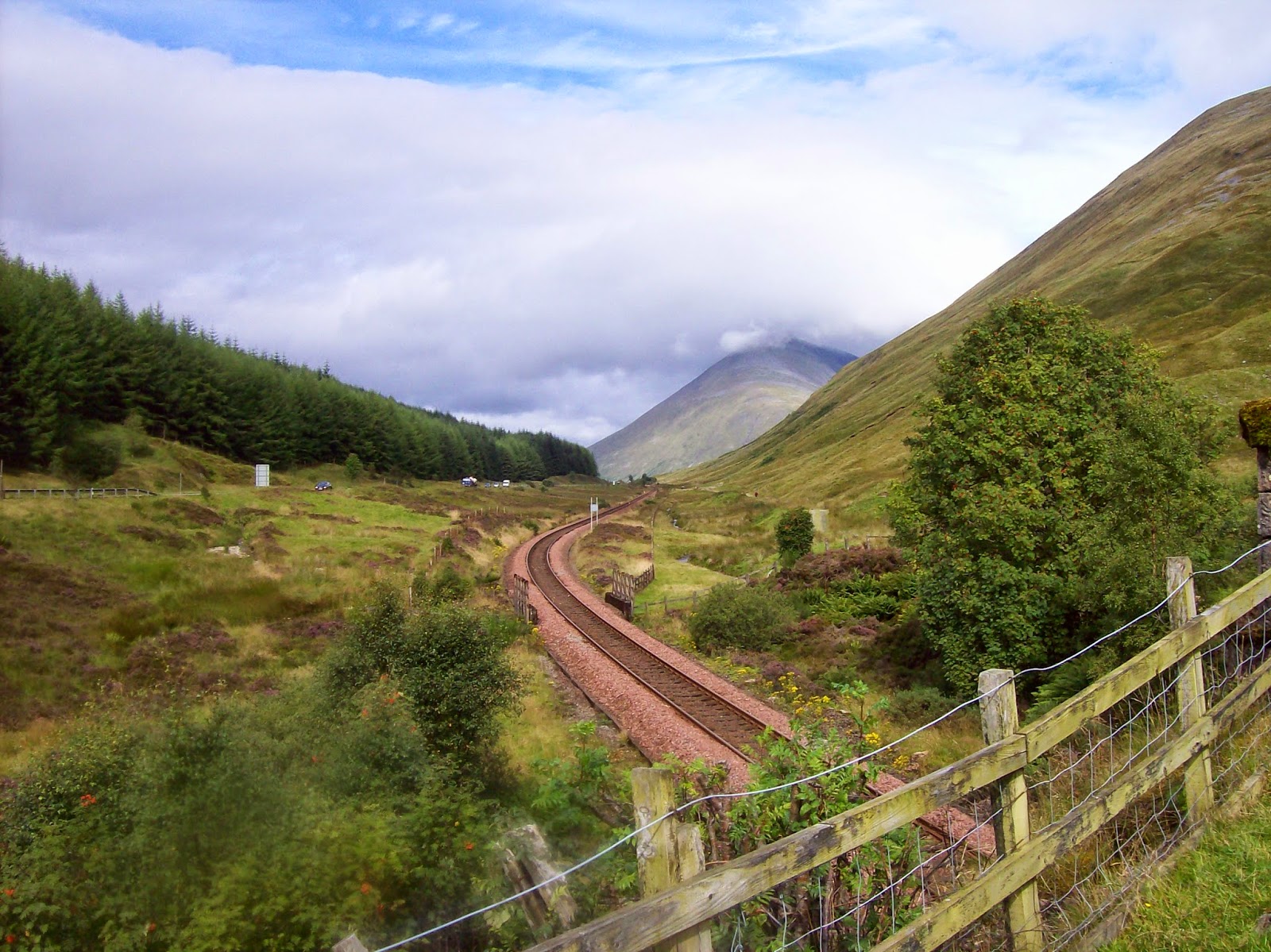
The path now followed the familiar line of General Wade’s military road, threading through open moorland beneath vast, watchful mountains. The weather held firm, and under blue skies the landscape revealed itself in all its grandeur—rolling greens, distant ridges, and the quiet sense of scale that Scotland does so well. We stopped for lunch on a soft patch of turf and watched a cheerful procession of walkers pass by singing “Side by Side,” complete with enthusiastic hand gestures. Close behind came Bob, still gloriously unaware of his atmospheric presence, now accompanied by another equally committed bivouac enthusiast. Together they formed what might best be described as a travelling olfactory experiment, but they were in excellent spirits.
There’s a strange thing about these journeys—you meet people intensely and briefly, share miles and moments, and then drift apart without ceremony. I realised, as Bob disappeared down the trail, that I would almost certainly never see him again.
The 'other' Ben Nevis and the tacky end ....
Later in the afternoon Colin and I peeled off from the trail and climbed a small turf-covered hill, drawn by the promise of a quiet vantage point where we might capture, on film, something of the vast and lonely character of the landscape. It was, in theory, an excellent idea. In practice, it lasted approximately twelve seconds. No sooner had we unpacked the camera and begun adopting what we felt were suitably contemplative poses than a cheerful party of Germans appeared as if summoned by the faint whirr of recording equipment. They fanned out obligingly across our chosen spot, wandering through our carefully framed shots and conducting what sounded like a lively discussion about entirely unrelated matters. We pressed on regardless, nodding politely and pretending this was all part of the plan.
To our right, dominating the skyline with quiet authority, rose the immense bulk of a mountain that had been growing steadily in stature throughout the day. It filled the eastern horizon, a great hulking presence that seemed far too important to be ignored. I found myself wondering what it was called. One of the Germans, evidently wondering the same thing, approached Colin and asked if this was Ben Nevis. Colin, with the calm confidence of a man working from incomplete information, shook his head and pointed off to the left, towards a distant purple ridge we had previously been assured was the real thing.
It was only as we descended back towards the trail that doubt began to creep in. Slowly, and with a certain reluctance, I came to the conclusion that we had either been misinformed or—more likely—had misunderstood entirely. The great looming mass to our right was, in fact, Ben Nevis. The ridge we had been admiring, photographing, and confidently identifying since yesterday was,
|
|
|
I pose in front of Ben Nevis
|
it turned out, just another mountain trying to do its best. Had Ronnie been present, we might have resolved the matter conclusively—either by correcting our error or confirming that he had simply read the map upside down—but the Two Ronnies had vanished at Kinlochleven, leaving us to navigate both terrain and truth alone.
And so there it was:
Ben Nevis,
suddenly unmistakable and apparently close enough to reach out and prod. It stood like an oversized milestone marking the end of our journey—the final chapter in a week of aching legs, battered feet, and chafed indignities. Strangely, I found myself missing it already.
The path climbed gently once more and led us into the dense conifer plantations of Nevis Forest, where the air grew heavier and more humid, and our old companions, the midges, returned with renewed enthusiasm. We passed through narrow ravines where the trees leaned inward, forming cool green tunnels that filtered the sunlight into soft, shifting patterns. It was, for the most part, rather pleasant—provided one ignored the persistent attempts of airborne wildlife to drain us of our remaining vitality.
At one point we came upon a loose cairn marking the site where a Campbell chieftain had fallen while retreating from the McDonalds. Without consulting the nearby information board, Colin and I dutifully added a stone, pleased to be participating in what we assumed was a respectful tradition. The sign, which we read afterwards, explained that supporters of the McDonalds were to add a stone, while those aligned with the Campbells were to remove one. Being English, we had, apparently, made the correct political statement.
Kath’s eyes narrowed slightly.
“Bloody English,” she muttered.
She soon announced the need for a brief detour into the trees. I have no proof, but I remain convinced that a certain cairn was subtly rebalanced during her absence.
We pressed on, fortified by Jungle Formula and the peculiar numbness it induced around the lips, which at least suggested it was doing something useful. A dragonfly darted past us with alarming speed.
“There must be still water nearby,” I observed.
“Why?” Kath replied. “Can you hear it?”
“No, it’s just that dragonflies need sti—hang on… how can you hear still water?”
The forest continued, Ben Nevis looming watchfully to our right, while occasional clearings opened up where trees had been felled. These areas had a stark, almost unsettling quality, resembling either the aftermath of a forgotten battle or a particularly untidy apocalypse. I have always had a soft spot for pine forests, but even I had to admit that mile upon mile of uniform greenery can wear thin. Still, there were signs of replanting with native species, and one could at least take comfort in the thought that future generations might inherit something a little more varied—assuming, of course, they were inclined to walk this far.
We crossed a wooden bridge over a lively stretch of water where oversized toadstools clustered along the banks like something out of an Andrew Lang fairy tale, and then re-entered the forest once more. The path rose and fell gently, and on one such ascent we passed a woman clearly struggling, though the exact nature of her affliction remained politely unexamined. Her companions urged her on with the reassurance that the end was near—“just another half hour”—a phrase we had learned to treat with deep suspicion. Hearing this filled me with a curious mix of hope and regret. It is not often that one wishes simultaneously for something to end and to continue indefinitely, but that peculiar contradiction seemed entirely appropriate. Eventually we reached a viewpoint from which Fort William revealed itself below, a slightly untidy spread of buildings nestled beneath the vast presence of Ben Nevis. We paused for photographs, Colin dutifully recording what was now, beyond dispute, the correct mountain.
From there, it was onward and downward. The path flirted briefly with the idea of repeating its Kinlochleven trick—appearing close, yet remaining stubbornly distant—but then, quite suddenly, we emerged from the trees onto a busy road. The final stretch lay ahead: a mile or two of tarmac.
It was, without exaggeration, awful.
After days of uneven, forgiving ground, the hard surface sent sharp reminders through every sore muscle and bruised joint. Kath in particular struggled, leaning heavily on her poles and moving with the careful determination of someone negotiating a truce with her own legs.
We slowed our pace and waited for her, determined that, after everything, we would finish together. And then, without fanfare, it was over.
A modest wooden sign, positioned beside a traffic island, informed us that we had reached the
end of the West Highland Way.
It was, to put it mildly, underwhelming. Certainly less grand than the polished stone marker back in Milngavie, and one couldn’t help but suspect that, without the nearby Highland Craft Centre, there might have been nothing at all to commemorate the occasion.
[NOTE Since we completed this walk in 2006 there is a new official end to the West highland Way. It can be found in Gordon Square in the centre of Fort William and is marked by a stone map of the route, benches, and the "Man with Sore Feet" statue, sculpted by David Annand].
Still, we took our photographs, filmed our final shaky footage, and stood for a moment as traffic hummed past. A small group nearby observed us with polite detachment.
“Just done the Way?”
“Yeah.”
“Well done.”
And that, as endings go, was that.
We said our goodbyes to Kath shortly afterwards and made our way to the Glenfer, where we were greeted by the luxury of space, hot water, and the promise of clean clothes. The landlady accepted our week’s worth of well-travelled garments with admirable composure.
“You’ve walked the West Highland Way then?” she asked.
We confirmed that we had.
She nodded thoughtfully. “I had some lads here last week who ran it all the way.”
Some people, I reflected, possess a rare and remarkable talent for deflating even the most hard-earned sense of achievement.
Beers in Fort Bill ....
Later, after a period of recuperation that involved very little movement and a great deal of quiet appreciation for chairs, we coaxed our stiffening legs back into action and made our way into
Fort William.
It proved to be far more agreeable than I had been led to believe—clean, functional, and reassuringly populated by the familiar fixtures of the British high street, as if the wilderness had politely stepped aside and allowed civilisation to resume normal service.
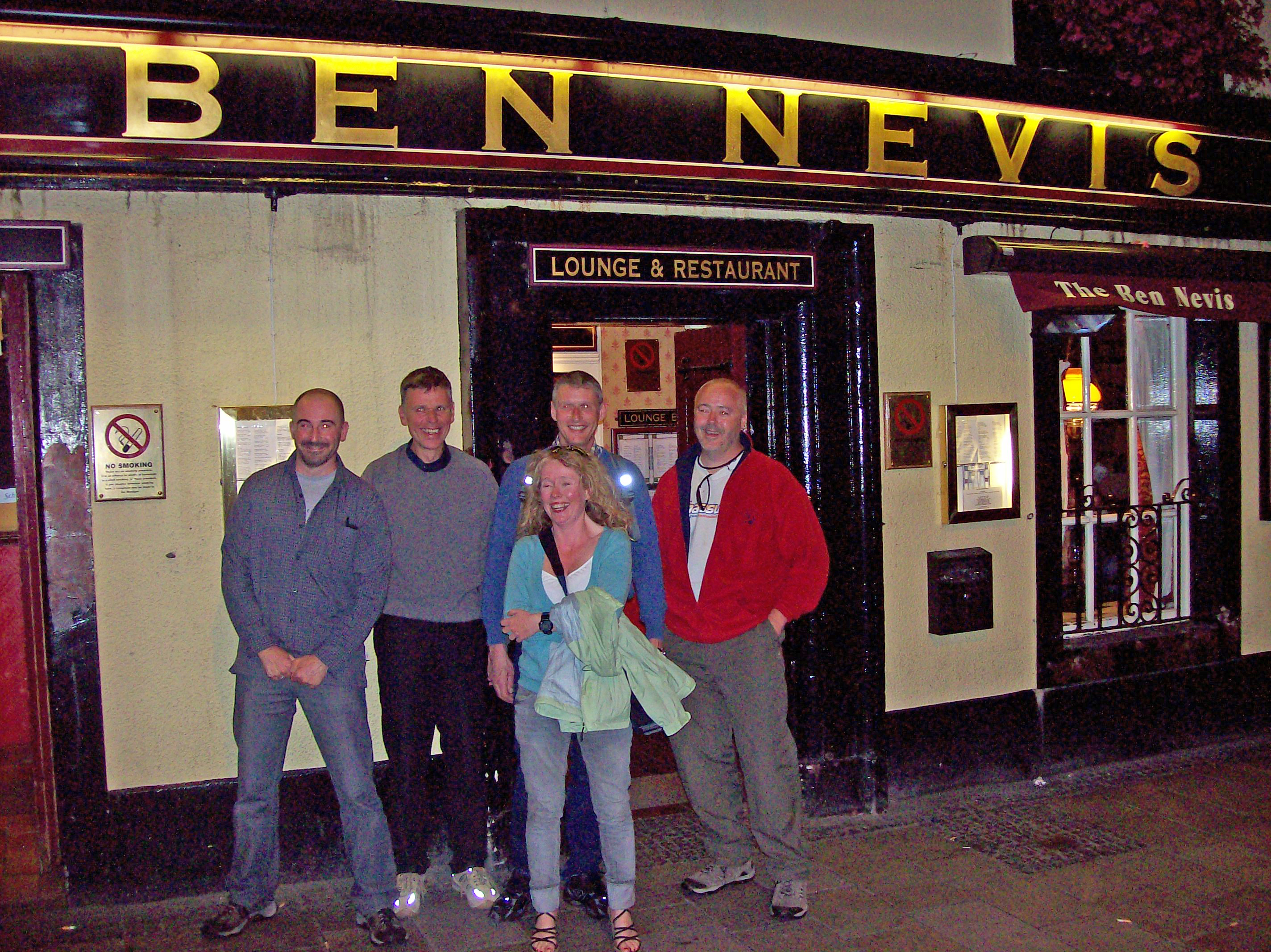
We found the
Ben Nevis Bar
without too much difficulty and were soon reunited with Kath, along with Manfred and Matthias, who appeared in excellent spirits and enviably robust.
I had heard so much bad press about Fort William that I was expecting something like Kinlochleven, sans mountains. In fact I found it quite a pleasant place. It was clean and functional with all the pre-requisite high street chain stores necessary these days before a place can consider itself modernised (and perversely removing it's character in the process). It was like scores of other large towns found the length and breadth of the U.K. The sort of place where you would take a Boots or a William Hill entirely for granted.
The Nevis Bar was a very busy place, deservedly so in my opinion as the staff were friendly and efficient and the food above average for the prices charged. Manfred and Matthias shared a few beers with us and chatted about what they were going to do next. They were intending to climb Ben Nevis the very next day and then take off to the West Coast for a week.
The Nevis began to fill to capacity as a stage was set up for the live entertainment. None of us were really in the mood for an evening of over amplified rock so we went in search of another drinking place. What followed was an entirely appropriate conclusion to the week: beer, laughter, and the sort of conversation that grows steadily louder and less structured as the evening progresses.
One bar led to another, as these things tend to do, and somewhere along the way we encountered Mr. Blister, now seated comfortably in the corner of a crowded pub. He wore a broad, contented grin, the sort that suggested his feet had either recovered miraculously or, more likely, had been rendered completely irrelevant by a sustained and enthusiastic intake of Deuchars. It was, in its own way, quite heartening.
Eventually, the evening began to wind itself down. We said our goodbyes to Manfred and Matthias with the kind of slightly over-enthusiastic embraces that only alcohol and genuine affection can produce, and parted company with a lingering sense that these brief friendships, formed in shared discomfort, had been rather more meaningful than their short duration might suggest.
Outside, a small, bespectacled man was engaged in a heated argument with his mobile phone. This dispute ended abruptly when he attempted to bend down, lost all structural integrity, and collapsed into an untidy heap on the pavement. We stepped carefully around him—there seemed little we could add to the situation—and continued on our way, feeling that this, too, was a fittingly British note on which to end the day.
And then it was just Colin and me again, as it had been at the very beginning. We wandered through the quiet suburbs of Fort William, talking over the week in that loose, reflective way that comes when something significant has just happened and you’re not quite ready to let it go. Street by street, we retraced our steps—until, quite suddenly, there were no more streets. The streetlights thinned, then vanished altogether, and we found ourselves standing at the edge of darkness, having walked clean out of the town and back towards the wilderness we had only just escaped. We paused, considered our situation, and turned around with what dignity we could muster, eventually locating our bed and breakfast more through persistence than any great navigational skill.
I had, at one point, entertained the idea of staying up—of sharing a quiet whisky with Colin, reflecting properly on the week, perhaps assigning meaning to it all. But wisdom, that most inconvenient companion of middle age, intervened. I climbed into bed, allowed the accumulated fatigue to take hold, and was asleep almost before my head found the pillow.
See Route on ......
Prev
Next