
| Offa's Dyke - North | |

|

|

|

|
The Golden Lion; a terse leave-taking, Darwin and Dickens, Llanymynech hill ....
We were up by seven and had soon packed our gear. Breakfast beckoned us downstairs and we ate a lovely meal while chatting to a man from Leeds at the next table. We then settled the bill with our host — and I baulked a little at the total, genuinely puzzled by the amount.
Bod discovered the reason when he came back downstairs and the manager asked for our luggage, so that he could take it forward. Months ago I had phoned the Golden Lion and asked whether they provided a luggage transfer service. I had been told they did, and the owner had simply gone ahead and arranged it for us, adding the cost to our bill. It was left to Bod to tell him that we had arranged transfer with the local taxi firm instead. I was upstairs in our room and didn't hear the eruption. The man had to reimburse us twenty pounds and apparently made his feelings known in a very strident and face-twitching manner.
"This booking has been a shambles from start to finish!" was one of his observations.
Bod employed superb distraction and de-escalation skills. He quietly told the man that we had enjoyed a lovely stay — which was true — and complimented him on his superb guitar collection. Such sentiments worked as a soothing balm on the manager's disposition. His neck stopped going in and out, his colour receded from brick red and he began to talk about his instruments and playing in general.
His wife was wonderful about the whole business and told us not to worry. To be fair, the original booking error turned out to be my fault. I had sent a deposit by cheque the previous March with a note explaining that we wanted to stay on the night of Sunday the fifth — which was wrong by a day. My only excuse is that I had sorted the week's bookings out after coming home from a twelve-hour night shift. The wife was very gracious about it. She also wins, hands down, the award for Best Packed Lunch of the Walking Week. It was excellent — varied, generous and lovingly assembled. God bless her.
Our taxi arrived and whisked us back to Llanymynech. We hoisted our packs on the canal bank in morning sunshine, discussing Bod's post-breakfast encounter with some amusement, and set out along the canal in single file with Bod leading. My legs felt better today and I happily trooped along for a mile or so before we began to suspect that all was not right. No acorn marker posts for a while, which was never a good sign on such a well-marked route.
 |
|
Bod – the man who stares at Sheep |
Bod and I stopped, consulted map and book, and concluded that we were lost. We had to backtrack to the starting point, where a careful scout around — combined with the map — revealed that we should have left the canal bank almost immediately. In our defence, and unusually for the Offa's Dyke path, there had been no signs to indicate where we should have gone.
The route required us to walk up a fairly steep section of the A483 to leave the canal and Llanymynech behind. Before long we were taken left onto a minor road and past an information board explaining that Charles Darwin had done some of his early field work in this area.
"I never liked his books," said Jo. "Particularly *Oliver Twist*."
"The Pope certainly didn't like his books either," answered Bod. The concept of evolution had not sat easily with the Vatican a hundred and fifty years ago.
The minor road soon became a steep climb up Llanymynech hill. Today's walking would take us through former mining areas around the town and past the remains of the old Oswestry racecourse. In warm sunshine we passed through light woodland as we climbed steadily, dodging the rain once more. We reached a brief plateau at Asterley Rocks and I stopped to film them — multi-faceted and broken, anciently carboniferous. The climb continued between stands of trees and vegetation until we reached the golf course on top of the hill, appearing briefly at the fourteenth tee before being ushered away to begin half a mile of meandering around the crown of Llanymynech Hill. The woodland here was not dense and the sun penetrated in shifting patterns on the track. The path had a habit of plunging half a dozen metres without warning and then regaining the height with interest on the next stretch. Jo found a dead mole on the path just before we began a descent into a steep gulley.
Here we came upon the Four Walkers from the previous day and exchanged pleasantries — mostly questions about each other's accommodation from the night before. I received a fair amount of ribbing when the story of my booking error and its effect on the nerves of the Golden Lion's manager was retold.
A dog called Alice, Sheep musings, a Slow Worm on Moelydd Hill ....
The descent from Llanymynech Hill was treacherous. The previous night's heavy rain had made everything slick and untrustworthy, the earthen track comprising long saturated grass and wet stones with polished surfaces. One of us was going to perform an unplanned series of gambols down the hill — on a couple of occasions it nearly came to that, and me. Bod in particular took his time easing his large frame down from the heights.
Jo and I let out audible sighs of relief when we reached the bottom and walked up to a wooden gate at Pen-y-coed, where a herd of cows was being shepherded along the adjacent track, leaving us no choice but to wait and watch. Bod and the Four Walkers joined us. One of the cows that passed had a deformed and twisted face. Another was being chivvied along by a man on a quad bike and was limping steadily.
"He's run her over three times already," Bod offered, by way of explanation.
We walked along a wide farm road and over some fields, crossing the disused Tanat Valley railway line with its overgrown tracks still in situ near Jones's Coppice. Passing through the seemingly deserted hamlet of Porth-y-waen, Jo commented on the amount of road and lane walking we had done that morning. We were winding along one as he said it, gazing at the residences and wondering where all the people were. The place had the feel of an early Sunday morning and we didn't see a soul. Then we had to duck up a steep path between two houses — back gardens on each side — and I noticed, a little uncomfortably, that there were a couple of very agitated dogs in the garden to our right. They were not impressed at our progress alongside their territory and made a committed attempt to reach us from behind a fence that, to my eye, was not nearly high enough. A woman in the garden began shouting commands at them, which were summarily ignored. Jo was behind me and as we cleared the alley he made a slightly amused sound and admitted that one of the dogs had made a grab for his face by lurching out over the fence top. It had only just missed him and he'd had to jerk backwards. "No way!" I exclaimed. Jo nodded and told me that he had heard the woman yelling at one of the dogs and calling it Alice, followed by a whiplash sound. "I thought — 'Alice is getting hers,'" said Jo, in a grimly satisfied manner.
 |
|
Bod and Jo on top of Moelydd Hill |
We descended through grass fields at Nantmawr, a helicopter clattering noisily overhead as we went, then back up through more fields past the tiny mining hamlet. These fields were steep. We crawled over a stile through a gap in a large old hedge and gratefully agreed, in silent consensus, to stop for a drink about halfway up the next hill. Sheep were doing sheep things in all directions. One of us asked whether we thought sheep had a language, or even a dialect. Did they recognise individuals by voice? If a sheep from West Bromwich were deposited on this Oswestry hillside, would the locals know her for a stranger with a funny bleat? We watched a succession of sheep bounce energetically through a hole in the hedge.
After the rest, I set off toward what looked like a gentle slope. Bod called me back and pointed out the actual route — an unpleasant discovery, as I had mentally prepared myself for an easy climb and was in no way ready for the frowning rise now in front of me. Very steep, with me staggering upward unhappily, though some Saint in the making had thoughtfully placed a bench at an advanced point on the hill. I sat on it while I searched for my breath. Jo seemed entirely unaffected by his exertions, which I think prompted me to call him a nasty name. The Four Walkers appeared through the hedge below us in a straggled line and began, one by one, to ascend.
This was the beginning of the climb up Moelydd Hill. We started again — another steep pull up through woodland on limestone scree, past a sign identifying the place as Jones's Rough.
"Yes, he is," said Bod, as he began to perspire and wilt on the southern slope.
We were walking through open, sunlit woodland alongside an old dry-stone wall when Bod found a Slow Worm lying inert on the ground. The warmth of the sun hadn't reached it yet and it was torpid and docile as I picked it up, just about summoning the energy to flick out a lazy tongue at me. Its skin was glossy and beautiful and felt silkily smooth. Jo held it while I filmed and it began to move with a little more purpose, though it was still cool to the touch.
"I tried putting a lighter under it to help," Bod said.
I released the slow worm onto the dry-stone wall and it glided smoothly out of sight.
Views from on high, racecourse relics, a family of mole catchers ....
We continued to the top of the hill, through the woods on earthy tracks, and at last broke out of the tree-line onto a plateau of short grass some nine hundred and thirty-four feet above sea level. It was breezy, but I hardly noticed. The view was fabulous. A Rotary International stone plinth on top had place names and distances engraved on a steel disc. Bod began pointing out landmarks — including Alderley Edge, just visible on the horizon some twelve miles south of Manchester, with the Cheshire Plain lying in a broad sweep before it. *"Where all the posh Manchurians live,"* as Bod put it. The Snowdon range was identifiable to the west. Looking back south, I reflected that the Sedbury Cliffs and the Bristol Channel, where we had started this walk the previous year, must now be around a hundred and twenty miles behind us.
We started again. The route backtracked briefly along the ridge toward the south in order to descend through more woodland — I assumed we would swing north again at the bottom. It had begun to hesitantly rain as we walked. A lane eventually brought us east and then north through the yard of Ty-Canol Farm and to a road, which we crossed to reach fields. The rain discouraged conversation and we were content to eat up the miles, climbing through fields and skirting the outskirts of Trefonen before entering a sprinkle of woodland and descending a wet track across a brook by a sturdy wooden footbridge. A steep pull after the bridge, then a field, then Candy Wood. We worked along a wooded ridge. Jo remarked on the sheer drop to our left — the trees on the slope had been forced to grow tall and thin as their roots grappled for purchase on the gradient. I realised as I offered some light-hearted reply that I was out of breath. The path levelled when we reached the summit of the ridge, where the wood had somewhere along the way changed its name from Candy Wood to Racecourse Wood — a nod to the old Oswestry racecourse somewhere ahead on today's route. A wooden bench offered a view to the east over smooth, bare hills that humped through a gap in the woodland panorama like a school of whales. We decided to stop and eat. Our wonderful packed lunches from the Golden Lion were produced in a renewed attempt by the rain to settle in for the afternoon. A chilly wind cut about us and I donned an extra layer. The bench carried one of those memorial plaques for a couple of whom it was said: *They loved these hills.* Tired from the recent climbing, Bod was not inclined toward sentiment. "In memory of Bod. He hated these hills," he said, with a laugh.
 |
|
Walking the lanes on the way to Candy Wood |
The Four Walkers caught up as we finished eating. One of them looked done in and wanted to stop, so we vacated the bench, left them to it and moved on. The track led through broadening woodland, the trees thinning until we left them behind and followed a narrowing path over several stiles toward the old Oswestry racecourse. I filmed Jo at the silent remains of the grandstand. It was a quiet place in the spitting rain — not quite enough for a thorough soaking, but persistent. I stood and tried to imagine the noise of excited crowds and the gaily dressed women of two centuries ago. It was hard to tell where the track had once run; trees have long since begun an invasion. Bod, in no mood for historical reverie, had walked off ahead and was waiting for us two hundred metres away.
Jo drew my attention to a plaque fixed to one of the stone walls of the grandstand, built it said in 1804.
"This building was later a home for a family of mole catchers," Jo read aloud, snorting with amusement.
We rejoined Bod and walked out onto a minor road, crossing the B4580. Our visit to the old racecourse had apparently stirred something in Jo, because he began telling me about gambling and how addictive it can become — admitting that in days gone by he had easily found himself laying down fifty-pound bets on the horses. I couldn't help expressing surprise. Jo nodded solemnly.
We walked on level tarmac for some time, the helicopter making another appearance above us. We passed Carreg-y-big Farm and dropped down onto fields flanking Selattyn Hill, passing through the tiny hamlet of Craignant before beginning to meander upward again through fields and alongside hedges past Mount Wood. The rain suddenly pattered down with more urgency. I stopped, made the decision to put waterproofs on, the other two following suit. Within minutes the rain stopped completely, leaving us to cook in our protective gear. Heavy sighs all round. We walked on sweatily, crossing a wooden bridge at the Nanteris ravine.
Climbing upward through wet grassy fields had become the reliable pattern of the day and we did more of it now, hopping over stiles at regular intervals. If one thing thrives on the Offa's Dyke path it is stiles of every conceivable type. The whole trail is said to contain over two hundred and we were in the process of encountering most of them.
Free range rabbit, the kindness of strangers, squalor in Chirk ....
We entered wild-looking pasture thick with patches of gorse. Jo observed that it was beginning to feel a little remote up here. The rain came and went as we walked and I became aware that my first blisters of the walk had arrived — both heels and the second toe on my left foot. One of the heels had probably already burst, as there was a familiar raw sting. Still, this was good going — three days in before my feet began to capitulate.
We reached a plateau on the crown of Bronygarth Hill. The Cheshire Plain was clearly visible now and Bod reckoned we could see as far as the Mersey estuary on the horizon. Prestatyn lay somewhere along that coastline — still invisible but out there, journey's end. Bod also identified what might have been Runcorn on the edge of sight. White smoke billowed in rolling clouds in the foreground, presumably from Chirk, our destination.
"That's probably our guest house on fire," Bod offered.
Chirk Castle was visible a little way ahead on a lower hill. We began descending the side of Bronygarth toward the Ceiriog Valley, down a lengthy grassed slope with gardens and farmhouses to our left, when we came across something piebald and floppy-eared, lolloping in grazing circles in the grass. A domesticated rabbit, puzzlingly at large, contentedly feeding in a small area when it had an entire pasture to choose from. It appeared unconcerned by our presence, but proved canny enough to elude me when I tried to approach. Jo went off to find someone at one of the farmhouses and returned with a puzzled frown and a shrug. We were forced to leave it as it was — an incongruous patch of black and white against the green of the slope. A perfect flag for a keen-eyed buzzard, I reflected.
At the bottom of the hill we reached the hamlet of Pen-y-bryn — a pretty little clutch of houses — and stopped for a drink and a brief assessment of the day's walk. We agreed it had been a challenging one, comparable perhaps to that first long-ago day from Sedbury Cliffs to Redbrook, though without the mashed toes. In Jo's case, at least.
We set off again, down a very steep minor road to Castle Mill, where a man was standing by the open boot of his car watching us as we stretched and winced and worked out the kinks. He turned out to be a fellow walker. After observing us for a while he offered us a lift into Chirk. I believe all three of us became wedged in the car door simultaneously in the rush to accept.
Chirk looked pleasant as I withdrew cash from an ATM to replenish my depleted supply. We nipped into the first likely pub for a drink and chatted to a barmaid, during which the first
 |
|
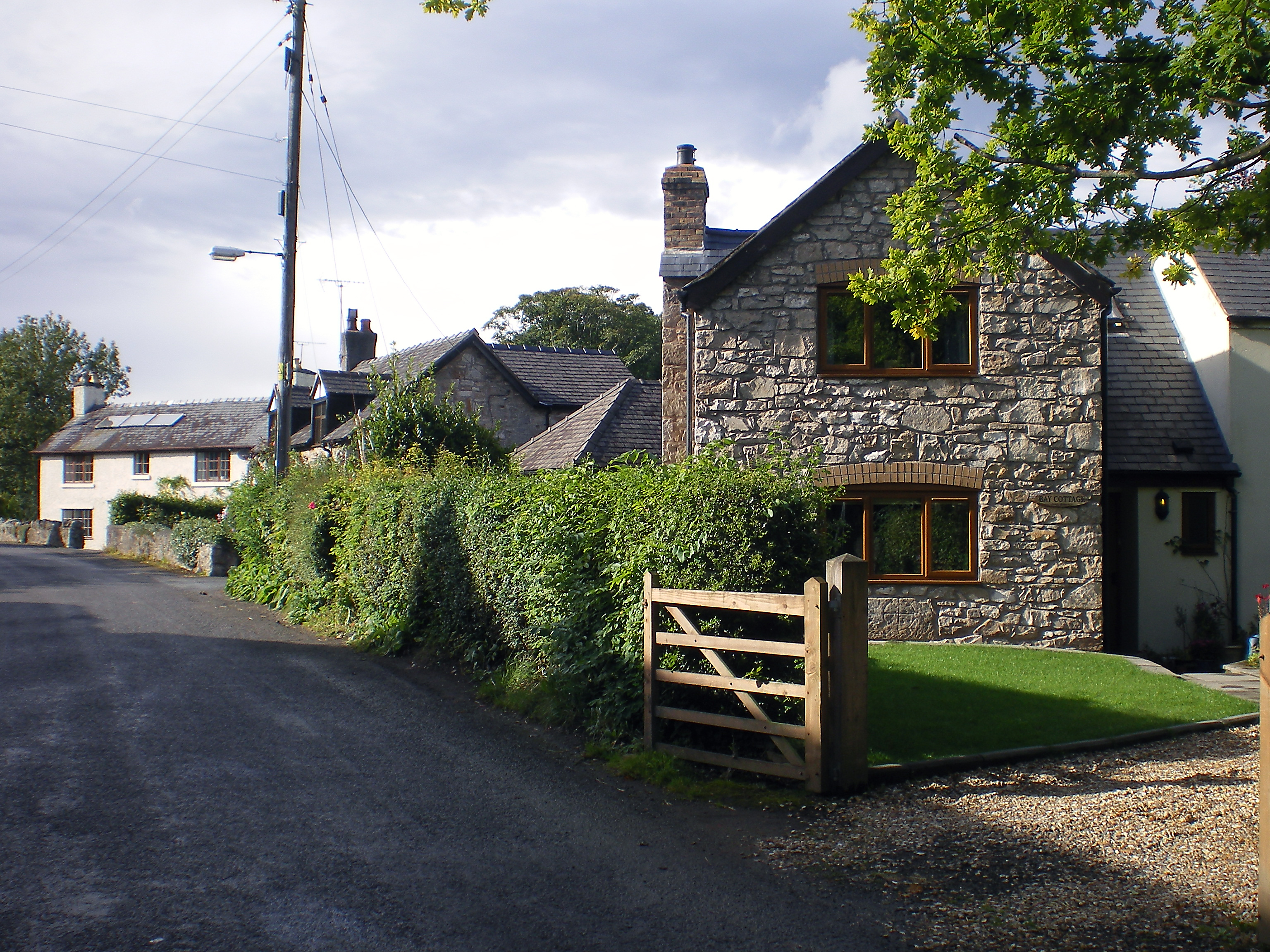
The pretty hamlet of Pen-y-bryn in the Ceirog Valley |
"There's room here, lads," she said. "It's better than where you're headed."
"Ah, but you would say that," Bod replied, with a grin.
She shrugged and said no more.
The Stanton looked okay from the outside. I put the barmaid's comments down to nothing more than an attempt to poach some trade. We walked into the bar. It was a bit unclean and seedy, but this simply meant we'd return to the other pub for drinks and a meal. No real problem. Bod and I approached the man behind the bar and announced that we had rooms booked for the night.
This was, I think, the moment the alarm bells started.
The man regarded us with what I am fairly sure was a faint sneer. He barely grunted any acknowledgement.
"Have we got your bags?" he said.
We confirmed that he had, and he said nothing further, walked from behind the bar and away from us without a word, still wearing that distasteful look. He clearly expected us to follow. He led us into the yard to a plastic shed, retrieved our luggage, and walked away again. We followed him upstairs and along a corridor that smelled of old food and dampness. He showed Bod and Jo their room, showed me to mine, and walked away. Throughout the entire interaction he had given me the impression of a man performing these duties as part of a parole arrangement. We never saw him again.
For my part, I was still absorbing the sights. The carpets on the stairs and along the landing were grubby and threadbare. The smell struck something from childhood — we had grown up in a rough area and most of my friends had been the poorer kids of the estate. This was the same smell I had encountered at some of their houses when I went round to play: a dirty, neglected odour, a pervading staleness.
My room was awful. Cheap 1970s furniture. A thin, scuffed carpet slick with grease. Chipped Formica cupboards. Bare, patchy walls. The British journalist John McCarthy would have recognised the place. Looking out of the window, I discovered with some amusement that the view consisted of the concrete side of a skylight approximately eighteen inches from the glass. Cigarette butts lay in a joyous drift against its base. I couldn't pass up such a filming opportunity and did a quick lens sweep of the room before laying out my wet clothing to dry on the radiator, the crusted sink and the tops of the cupboards. My waterproof I hung inside a cupboard containing insulated pipes. I had felt sweaty and in need of a wash anyway, but my new environment left me feeling that vigorous scrubbing with industrial soap was the minimum required. I walked along the corridor in meditative silence. The wallpaper and carpet patterns clashed and clamoured for attention simultaneously. My eyes weren't sure where to settle
My God, I thought. What a fucking dump.

I do not exaggerate in any of the above. This accommodation was disgraceful and any walkers reading this who are planning their own assault on Offa's Dyke should avoid the Stanton House Inn in Chirk with the same commitment they would bring to avoiding a genuine plague. I'm not suggesting you'll catch the plague here, of course. Even rats have standards. Once I had bathed, the three of us reconvened and swapped horror stories. Fortunately there was a great deal of laughter about it all. We agreed, as Bod put it, to take the hit on this one and get the hell out in the morning. It then occurred to me that I was responsible for my brother's video camera as well as my own, and that both would be left in my room while we went out. I had no proof that any skulduggery would occur in our absence, but my faith in humanity around here had been, shall we say, dimmed. I found a loose floorboard in the cupboard where my coat was hanging and stashed the equipment in the cavity beneath it.
By seven we were back in the first pub we had visited on arrival. The barmaid gave us a knowing, told-you-so look that had us grinning ruefully. In any event, we had a good evening — drinks, a lovely sausage and mash, the England match on the television, which ended three-one to Switzerland. Bod and I played pool. I had some muscular aches from the day's hard walking but otherwise felt fine, and if the thought of returning to our doss-house dampened my mood briefly, it wasn't for long. I said goodnight to the others and took myself back to my own room. It was typical, I reflected, that when it came to my turn for a room to myself, I had ended up with the Calcutta flea pit. I got undressed, into bed, read briefly, and settled down to sleep.
Daily Tweets
Twitter from @BabbleRouser (Jo)
Think we broke the land-speed record yesterday; 10 miles in about 3 hours. Today called for a more strenuous effort
Sep 7th via mobile web
Twitter from @BabbleRouser (Jo)
If we all make it out of this 'hotel' alive, it will be more than a minor miracle!
Sep 7th via mobile web
Twitter from @BabbleRouser (Jo)
Many lovely people in the world; fellow walker ferried us from end of today's walk to our accommodation. Top man!
Sep 7th via mobile web
See Route on ......
|
|
|
|
|
 Prev
Next
Prev
Next

No comments:
Post a Comment