
| Offa's Dyke - North | |
|
By Colin Walford
Day One Route: Knighton to Montgomery Distance: 15m (24km) Elevation: 463ft (141m) to 1,398ft (426m) Climbing (ascent and descent): 3,301ft (1,006m) and 3,468ft (1,057m) Next 
|
|

|

|

|

|
Travel sickness, reluctant walkies ....
Our assault on the toughest part of the whole Offa's Dyke trail had an inauspicious start, with *start* being the inoperative word. We couldn't set out from my place near Ross-on-Wye until Bod and Graham — Graham hadn't completed the first half with us the previous year, due to personal circumstances — had gorged themselves on a fatty breakfast of dead farm animals and then called in on Jo and me.
We had a hell of a distance to drive before we could even lace on boots for the business end of the day, so we packed up and set off in a sharp manner. It took about an hour to reach the Brompton Crossroads and I chose to travel with Graham in his car, since we hadn't seen each other for several years and would have the chance to catch up on life. This passed the time pleasantly enough, but I became increasingly aware that I wasn't quite feeling all the ticket. The awareness arrived in direct consequence of the quantity of twisty country roads we were encountering and speeding around. Travel sickness was upon me. It is a horrible thing and, as the nausea increased, I was reduced to nodding my head and grunting agreement with whatever Graham was saying. Open conversation became secondary to the need of keeping my recently consumed breakfast inside my stomach, where it belonged.
I had a brief respite when we stopped at the Crossroads, but all too soon we were back in Bod's car — leaving Graham's behind to bring us back to Knighton at the end of the day — and whirling merrily around right-angled bends. I began to feel very ill indeed.
"Bod — stop the car," I said tightly, and lurched outside to perform a series of dry, barking retches. This produced nothing but eyes full of tears and grins from my fellow travellers. We tried again and were nearly in Knighton when a second wave of biliousness engulfed me. My body developed a strange numbness and I seriously thought I was going to conk out.
"Bod — stop the car."
This time, I produced the goods. Half-digested porridge of an orange hue.
Sheepishly, grinning weakly, I returned to the car.
"At least you're still smiling," said Jo.
We arrived at the The Offa's Dyke centre in Knighton at just past noon. A fine time to be starting a challenging fifteen-mile walk. General preparation took place: changing into walking gear, me doing a little filming, and Jo striding off to find the local toilet. We also watched with stifled amusement as a lady attempted to get her unwilling dog out of her car for walkies. I have never seen a more recalcitrant beast. Its owner was reduced to dragging it along on its lead, paws skidding audibly on the pavement and eyes rolling with reproach. She became aware of our watchfulness and gave up, returning to the car with a bashful and rueful expression.
At last, we were ready. It was half past twelve.
"How's your night vision?" Bod inquired of everyone.
We started off on a path that took us away from the centre and through a recreation ground. We were no more than two minutes into the walk when Bod stopped and began rooting through his rucksack.
"What are you looking for?" asked Graham.
Bod surfaced from the depths with an irritated look. "I've left my map in the car."
Graham shrugged. "I've got a GPS and Colin has his book. We're not going to get lost."
Panpunton Hill, Noble & Waters, over-engineered sandwiches ....
With this undeniable logic, we walked onwards and soon approached the River Teme.
Graham and I strolled together past a group of kids idling by the riverbank. Conditioning borne of growing up in Chelmsley Wood had me braced for derision and stone-throwing, but nothing happened and we passed on. It was quite sunny at this point of the day, the river dancing with light as we walked along its bank. We were in England here. I wasn't entirely sure when we would pass into Wales, but this was nothing new — I'd spent most of the first half of the walk the previous year not quite knowing which country I was limping through.
We crossed a footbridge and were suddenly faced with our first climb. Panpunton Hill wasn't inclined to introduce us to proceedings gently. It was immediately steep and took us up quickly to four hundred feet, revealing a good view over the town we had just left. A brief rest was required as the climb levelled briefly — the air was close and humid — and then we took off again and marched to the summit of the ridge. Graham looked unhappy.
"My Achilles is hurting."
 |
|
Setting out from Knighton |
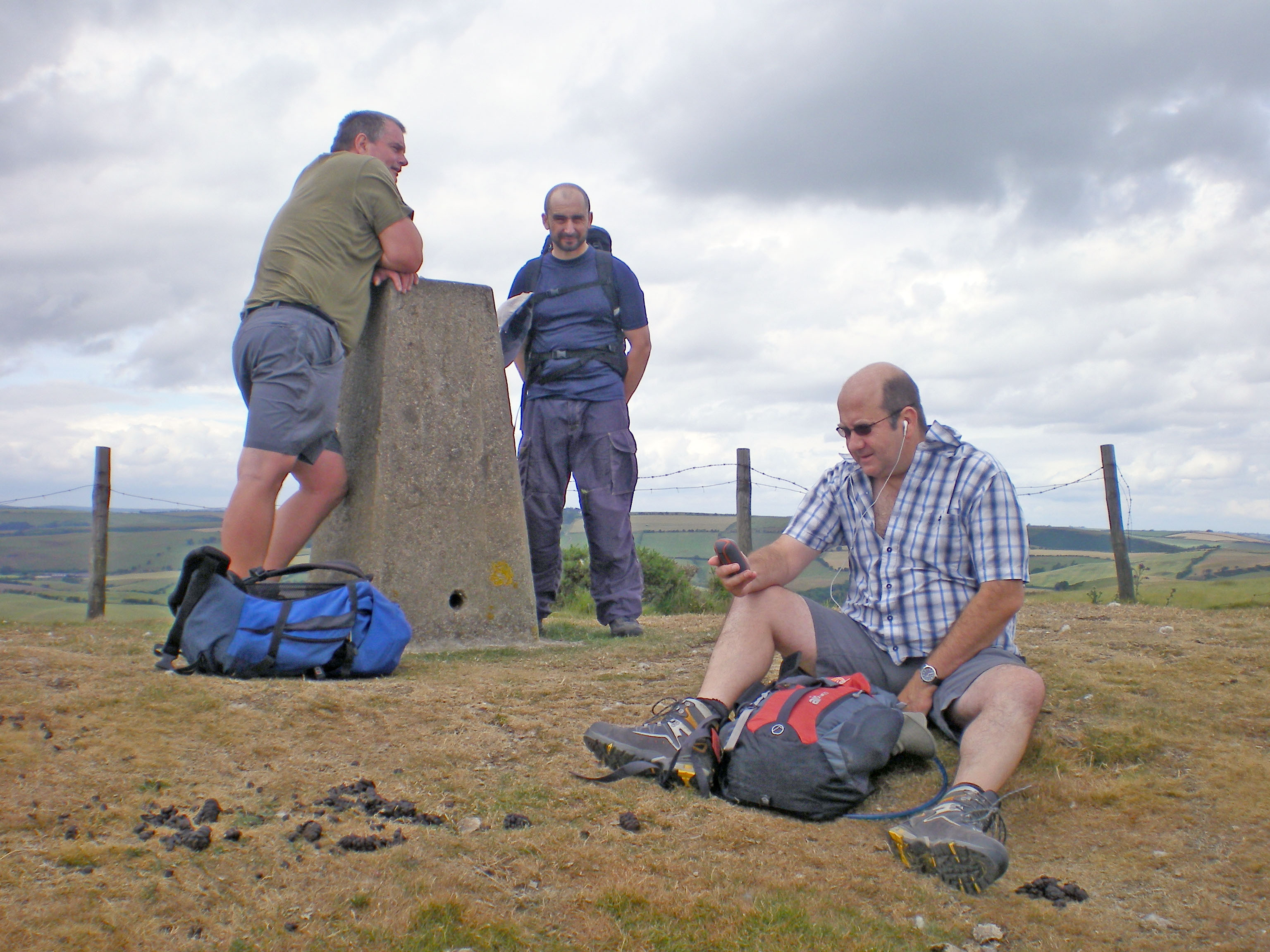
Nobody knew quite what to say to this so early in the walk, so we simply continued when he had massaged his leg and completed some vague stretching. We came across a weather-chewed wooden bench, dedicated according to my book to a Frank Noble of the Offa's Dyke Association. It had collapsed in on itself over time and appeared to be the main feasting point for colonies of woodlice. You couldn't help but ponder the precise definition of the word *dedicated* in this instance. There was also a cairn here, in memory of Roy Waters of the Tref y Clawdd Society, a man who had worked hard to open the Offa's Dyke path. The cairn still looked strong and secure, unchewed as it was by invertebrates. Frank Noble's bench could have learned something from it.
The view at the top of the ridge showed the River Teme snaking westward to a deeply-arched viaduct at a place called Knucklas, which managed to look impressive even at a distance. We walked along Panpunton Ridge for over a mile, the unspectacular hump of the Offa's Dyke crest keeping us company just to the right, the Teme Valley and the opposing ridge of Beacon Hill to our left. This was easy walking after the first climb and I felt good.
Before long we were taken down and around a deep cwm. The drop to our left was severe. Jo commented that there would be no stopping yourself if you fell down that slope. He was behind me, and moments later I heard the unmistakeable sequence of a stubbed boot, a trip and a scatter of pebbles. A moment of silence.
"I've just nearly demonstrated what I was saying," Jo murmured.
We negotiated a track beneath light woodland and then were climbing again — another steep one, enough to set my leg muscles burning. I was quickly reduced to a gasping, open-mouthed entity in a sweat-sodden T-shirt. Finally we gained the summit of Cwm-Sanaham Hill, which rears proudly to 1,343 feet. A trig point at the top always provides a good excuse to rest. As I gazed about me I noticed it was becoming both cloudier and cooler. Llanfair Hill lay ahead, and beyond it Kerry Hill Ridge and Corndon Hill.
We descended — gently at first and then with more purpose, going steeply down through stubby gorse. Bod, Jo and I watched a pair of Red Kites as we went. One of them was issuing a strange, unusual call.
"We're still alive!" Jo called up to the sky.
Bod answered that they were following us patiently, waiting their opportunity for when the ascent of the hills finished us off. At times they flew quite close, not seeming to be timid birds, despite their history of persecution.
The descent levelled out and we crossed a couple of shallow rivulets. Jo opened a metal gate and we passed through the sparse grounds of Garbett Hall and up a short incline. The path divided ahead of us around a thick hedge of gorse.
"It probably meets up again at the top," said Jo. It did.
Jo and I walked in the lead together, talking about this and that. This became the usual pattern for the day, Bod following us and Graham behind, often walking along with white earphones in place. I never did find out what he was listening to, so I decided it was a recording of Mickey — Rocky's trainer in the films — which Graham played to himself when struggling up the inclines.
*Get up that hill, kid! You're gonna eat lightnin' an' you're gonna crap thunder!*
*Keep away from women! Women weaken legs!*
*Them hills are gonna keep hittin' ya! Hittin' ya in the ribs, ya see?*
Just after Garbett Hall we faltered. The Offa's Dyke signpost became unusually speculative. As we debated it, a very young face shot past in a Land Rover — startling, as the young face in question appeared to be the driver. He looked about twelve. As the vehicle disappeared in a cloud of dust, Bod pointed at an abandoned hulk of a vehicle nearby.
"He arrived in that one."
We had come off the route — we needed to be walking up the field, not across it — and Bod pointed out the unmistakeable hump of the Dyke. Of course. This was Offa's Dyke. Nothing went across. It always went up. We traversed back across the field and the young driver reappeared in the Land Rover, leaped out and immediately climbed into the cab of some farm machinery. He began mowing down swathes of vegetation in the neighbouring field with a nearly constant happy grin on his face. An early start to the career, but he seemed perfectly suited to it.

"No wonder my backpack is heavy," Bod spoke up as he unwrapped his own food. "There's about twenty kilograms of aluminium foil around these Scotch Eggs."
I had packed the lunches. I scowled at him.
Fly flapping, Graig Hill, evidence of werewolves, unexpected Belgians ....
We ate mostly in silence. Graham and I consulted his GPS and my book to establish where we were, and correctly established that we were past the peak of Llanfair Hill and shortly to descend its northern flank. Jo and Graham lay back on the ground and nodded off. Graham began to snore in uneven bursts, making Bod and me grin. Bod had only eaten half his lunch and later admitted he had begun to feel dehydrated despite sinking four litres of liquid throughout the day.
After forty minutes I was bored and wanted to be off.
"We're only putting off the inevitable," Bod agreed, and we both started gathering our gear. After a pause, Graham and Jo followed suit.
The ridge began to turn downhill and within a few minutes I felt stifled in my coat. The sun was making occasional appearances through breaks in the cloud and Bod, walking alongside me, gave me a dry look.
"Are you warm enough?"
That decided it. I stopped to stow the coat and do some filming. As I set off again I turned a corner onto a lane and found Graham sitting on a grass verge, waterproofs stubbornly entangled around his boots. I watched Jo and Bod go over the top of the rise ahead and disappear into a dip. I followed up but found no sign of them at the crossroads — weatherbeaten road signs beaten into near-indecipherability by the elements. I thought I needed to turn right. This was confirmed when I spotted Jo some metres ahead, peering back to make sure I'd taken the correct route.
Then the flies found me. Fast and insistent, repeatedly settling on my head, neck, nose or eyebrows as the fancy took them. I suppose they were interested in the light glaze of sweat I was wearing, but they were a bloody nuisance and my hands were constantly flapping about my head in an attempt to disperse them. Largely pointless — they returned after a couple of seconds. Swearing at them was equally futile, but it made me feel better.
At Springhill Farm I was directed left and over a wooden stile, on top of which was a sprinkle of sheep droppings. Not on the steps, but on the post you use to steady yourself as you heave over the fence. This was either one very large or one extraordinarily athletic sheep. Jo and Bod were side by side examining an information board about this section of the route, held under a sheet of perspex.
"Don't look at it," advised Bod. "It won't make you feel any better."
 |
|
The summit of Panpunton Hill |
Pish.
I checked against my book, which suggested we were nearer to halfway. That sounded more like it.
A steep downhill track through a valley of green ferns brought us through the farmyard of Lower Spoad Farm. I tried to run ahead of Jo and Bod to photograph them walking past a large shed crammed with rolled bales, but they were quietly unenthused and just kept walking. The resulting photograph will not win any prizes. The place seemed deserted, but then a Border Collie appeared and moved towards us across the yard, tail wagging with enthusiasm.
Jo warned me off. Border Collies, he informed me with deep paranoia, are clever enough to pretend to be friendly in order to get close enough to begin removing parts of you.
"That's how they get you," he finished.
I thought this was a ridiculous notion but stopped communicating with the dog, which looked either crestfallen or thwarted, depending on your point of view.
We crossed the B4368 and into fields heading north toward the floor of the Clun Valley. I had lost myself in a pleasant reverie when Bod spoke.
"I think that's where we go next — you can see the line of the Dyke."
I gazed with some awe at a vicious ascent up the broad flank of Graig Hill. I could see the Dyke and also two insect-like figures on the slope who, even at that distance, appeared contorted with misery as they inched upward. We walked on down to the River Clun, crossed it via a wooden footbridge and passed through a belt of light trees. I passed two enormously bloated sheep lying recumbent in the grass. They didn't stir as I walked directly past them — unusual, as in my experience sheep retain, despite thousands of years of domestication, an almost pure terror of human beings and scatter like rolled dice at one's approach, often sprinkling pellets of dung as they go. I decided some pre-climb commentary was in order. I made optimistic noises about how manageable the walk had been so far. Yes, there had been climbs, but it was all very okay. Then I walked to the base of the ascent, where a water tap had been thoughtfully placed — a touch which I read as a faintly ominous warning of the torture ahead. I didn't bother refilling, reckoning I still had plenty and couldn't be arsed to remove my pack. Bod and Graham began filling up. Jo and I started the climb.
It revealed itself to be steep and grinding without delay. I was quickly breathless and had to resort to using my hands on my thighs to push myself upward. Thank God I had spent the previous month jogging regularly on steep roads. My leg muscles had strengthened noticeably and my aerobic capacity had improved, which had surprised and relieved me in equal measure, considering how short a span of time it had taken. Given the chance, the human body will really try to look after you. This climb burned my legs and had me heaving for breath, but I made it in one go and reached the top without any cardiac event.
I filmed as I got my breath back, commentary acknowledging the difficulty of this particular switchback. Jo drew near as he also finished the climb and threw me a dubious expression. I grinned.
"How d'you like Graig Hill?" I called out to Bod as he lurched towards us, crimson-faced.
Bod ignored me and told us he was feeling unwell. Headache, nausea — classic dehydration. Too many pints the night before? The salty English breakfast? Bod would have none of it. He told us the water from the tap below had tasted horrible too, which I noted wasn't technically a refutation of either of my other theories.
As Bod began to recover his vigour, I mentioned that there was an even steeper climb just ahead, according to my book.
Jo looked disbelieving. "How can it be steeper? It must mean longer."
I considered having second thoughts about not refilling at the tap below, foul-tasting water or not, and mentioned this out loud with a joking reference to going back down for it.
Bod came alive. "Go down now," he advised. "Just give me the camera and let me film you struggling back up, you bastard."
Graham joined us a few minutes later, swearing at his Achilles. We rested briefly and then turned to move on. The valley ahead fell sharply to the west and Corndon Hill filled the view — broad, with a flat top and knobbly protrusions, standing at 513 metres and known as the Neolithic Axe Factory for the archaeological finds there. We had to descend into a minor valley before going back up Graig Hill for a second time. This is the way of Offa's Dyke.
Bod was not impressed.
"Why?" he asked. "Why can't we do that flat bit over there?" He pointed a shaking finger. "I like that flat bit!"
Nevertheless, we pressed on. Bod stopped dead when he saw what lay ahead. Jo saw it and laughed, which I have learned he sometimes does when confronted with a ridiculous climb that is going to hurt.
"So where are we supposed to go?" Bod pointed to a sensible, pleasant track that skirted the monster ahead. "I'll bet it isn't there." He was right. It wasn't.
Cows were dotted about impossibly on the acute slope. I consulted my book and called Bod and Jo back — Graham had already heard me.
"We have to go up that track by the larch trees," Graham pointed.
It was a difficult path. The soil was broken and dusty, the footing mutinous as loose stones shifted underfoot. This only compounded the exertion of the climb. My breath came in gasps, my T-shirt was drenched at the back, but I got myself into a rhythm and made the top with Jo. We waited gratefully. My next piece of filming had me acknowledging that the day's walk had turned out to be a hard one after all. I had spoken too soon earlier.
When Bod and Graham joined us we all needed to rest again. Bod was waving his hat irritably at a cloud of flies that appeared to have adopted him as a permanent fixture.
"They think I'm a corpse already."
We were grateful for the descent that followed, even knowing it meant another climb further on. Jo and I walked together. Abruptly, we came across the wet, open carcass of a dead sheep lying right next to the track. The smell hit us as we reached it. Most of the abdominal cavity was exposed and crawling with flies, and its head was thrown back towards us, two bottom teeth jutting forward from a gaping mouth.
"What do you think killed it?" I asked. It looked as if something large and hungry had been at it. This confirmed the presence of a werewolf in the area as far as Bod was concerned, who had been warning us not to wander off the track at intervals throughout the afternoon and had been humming Bad Moon Rising to himself now and then.
We continued downhill through fields, hedges and rows of trees. Jo seemed determined to seek out the steepest ground, often detouring to scale a small ridge or hummock. I asked what he was doing and he pointed out, quite reasonably when I looked around, that he was avoiding banks of nettles on the low ground.
Graham remained low profile throughout much of the walk, following us silently like a ghoul with an iPod.
Bod, Jo and I walked together along a thickly-hedged lane and crept around the shoulder of Hergan. A further descent was immediately followed by a steep ascent, slightly tamed by a flight of wooden and beaten-track steps. It still looked nasty.
"Uh-oh," was Jo's only comment as we started up.
The steps petered out to a more humane climb, which levelled out and then meandered upwards again toward Middle Knuck — a former farm turned children's home, according to my book. Jo and I drew ahead and twitched our noses at the same time near a footbridge.
 |
|
Jo |
We climbed again up a narrow track through the vegetation. Jo pulled ahead and as I reached the crest he was standing by two young men sitting on a grass bank. "Can you show them your map, Col?"
I walked up and sat by them. "Now then, lads — what do you want to know?"
They were Belgian, and spoke excellent English. One of them showed me on their basic map where they thought they were — somewhere between Middle Knuck and Lower Knuck — and he had been more or less correct. They had started at the Sedbury Cliffs near Chepstow the previous Monday and were doing the whole walk in one go, hoping to finish by the following Friday when they were booked to fly home. More immediately, they wanted to reach Montgomery in time to find a pub with a television showing the World Cup third-place play-off between Uruguay and Germany.
I looked at my watch. Half past six.
"Not a chance, lads."
The map-holder nodded. "Perhaps the second half," he smiled.
He asked how far I thought Montgomery was. I said about four miles. In retrospect I think I was out by a couple of miles in his favour. We wished each other luck and they set off ahead of us.
As we started off again, Bod mused on whether they were supporting Uruguay or Germany.
"It's funny," he added. "They come all the way over from Belgium to walk Offa's Dyke and most of the people who actually live in Britain never do it." "Most people don't like walking," I said. "Which means those of us who do are more likely to meet each other, wherever we are." I thought of my own notion of walking some of the pilgrim trails in Spain one day. "What gets me is how excellently everybody else speaks English."
Jo nodded. "Makes us seem very lazy, doesn't it?"
Reluctant movie stars, Corndon Hill, the Bovine Fan Club, Badgers ....
We We walked on, up through a field of giant and straggly thistles. I photographed them.
"Watch their heads turn to follow us," Bod warned, likening them to Triffids.
One by one we climbed over a stile and set out across a field that began to turn downhill. Graham caught his foot on the top of the stile — distracted, I think, by me photographing him — and took a sprawling dive from it. With surprising aptitude he managed to remain on his feet as he stumbled forward, arms flapping like an ungainly bird. I laughed, but did remember to ask if he was all right.
We briefly caught up with the Belgian pair as the path turned sharply downhill, but they were soon on their way again. We reached Knuck Bank and rested on a minor road — partly because the biggest climb of the day was just ahead in Churchtown, and partly to let Graham catch up. After a few minutes of mental preparation, we started a big and sharp descent into Churchtown Wood.
The track went beneath both conifer and broad-leaved trees. I turned to photograph Bod walking towards me.
"You're like one of those photographers at the Jewish death-camps, capturing people's suffering," he said, which I thought was a bit strong.
I stopped to do some filming, so was the last to emerge from the wood and behold the tiny hamlet of Churchtown — little more than a church, a graveyard, and not much else. The other three were gathered by a stile at the foot of what was clearly going to be a significant climb. I was still filming and Bod muttered something to the others as I approached. I suspected the camera wasn't proving entirely popular. "Got something to say, Bod?" I inquired. "Have you got any German or Japanese blood in you?" Graham replied. Bod had evidently shared his Second World War atrocity theory. "You're like Hitler's propaganda minister — what was his name?" He turned to Graham. "Goebbels." "I'm not evil, just factual," I said, and gazed at the ascent ahead. The graveyard was right at the foot of the climb. "They've already got my plot dug over there," said Bod. "Yeah — and if we die en route, there's a conveyor belt that ships our bodies back down to the church." I asked if the Belgians were already on their way up. Jo nodded. "They saw me approach and immediately got up and left. You could see their enthusiasm at greeting me decreasing each time we met." We began. This climb was a challenge of endurance, nothing more — very steep, very tiring, and we were weary enough by now that it seemed worse. I was back to pushing down on my thighs. Jo seemed just as strong as ever and fairly powered his way up. I followed more slowly and we lost sight of Bod and Graham below. There was one of those dispiriting false summits that draws you in and then, on arrival, reveals a further ascending track through ferns beyond. I inwardly cursed. I didn't have the breath to do it out loud. At last I walked to the top of Edenhope Hill. The view was wonderful, but I couldn't appreciate it until my red blood cells had refuelled my brain and returned some colour to the world. Jo and I waited for the others by another stile that looked out northward — the direction we would continue when we returned in September. Corndon Hill dominated the view ahead. To the east, a line of purple ridges marked the Shropshire Hills. In a nearby field, a lone haystack stood sentinel in a flush of sunshine. Bod and Graham appeared and we all rested and nibbled on lunch leftovers. It was breezy up on the ridge despite a shelter of trees, and as the sweat cooled on my body I actually started to feel chilly. The sky remained cloudy with windows of blue, through which the sun broke occasionally and spotlit distant fields. We reflected that we had one more serious climb ahead of us, up into Nut Wood. "At this rate, we won't finish until eight o'clock," I told Bod. He nodded thoughtfully. "Try nine," he said, and I had to agree. We descended to the upper valley of the River Unk. The final climb managed to fool us. We first saw a track that nudged kindly upward. Just as hope began to rise, it skipped away to the left and stopped climbing, and the real track manifested before us, bounding vertically with familiar zeal. The ruse was all the more hurtful because the roots of the track began in such a pretty and flowery dell. We laboured up the slope of Nut Wood — another steep path, finally conquered — and emerged onto the Kerry Ridgeway. This ridge, running east to west, forms part of the England-Wales border. I stopped to film and, for the first time, noticed that my feet were becoming sore. We strode on and dropped six hundred feet in just over a mile onto the Montgomery Plain. Another steep drop brought us eventually to a road and then the grounds of Mellington Hall.
 |
|
View from the Kerry Ridgeway |
"Come on, then."
This seemed to confuse it and it backed away a pace or two. In this manner I made my way over a stile and joined Jo and Bod in safety, then filmed Graham getting the full Bovine Fan Club treatment.
As we marched on through a large campsite, the woods grew gloomy beneath the tree canopy as evening drew in. I noticed that all three of my companions had stopped walking and were standing very still. Puzzled, I approached Graham, who leaned toward me and whispered that Jo had spotted Badgers just up ahead.
Graham pointed them out. Two badgers were sociably grooming each other just outside the entrance to their sett. In the dusk light, their white stripes stood out with an almost glowing fluorescence. I was delighted and carefully crept closer, turning the video camera on.
They nibbled at each other's fur. Then one would stand and scratch heartily at itself with a hind paw. They must have been as lousy as rooks. They were only fifteen to twenty metres ahead, but badgers have notoriously poor eyesight and, luckily for us, the light breeze must have been blowing toward our position. One whiff of four sweaty human bodies and they would have vanished in a flash. As it was, they snuffled and scratched for a good few minutes and then wandered back underground in unhurried fashion. As one, we moved forward again. I filmed the entrance to the sett and whispered some commentary, at which one of the badgers chittered briefly. I decided to give them some peace and walked on.
It was nine o'clock and the woods were getting darker by the minute. A heavy perfume began to pervade the air. We approached a medium-sized tree adorned with large, tulip-like white flowers, quite impressive in the gloom of the canopy. I attempted to photograph Graham walking beneath them.
"What — you want me to wear them in my hair?" he remarked, which was a curious comment from a fellow baldy.
We left the wood behind and passed Mellington Hall itself, getting ourselves slightly misdirected. Rather than finding and walking beneath the arched gateway, we continued down a small lane that rejoined the route just after it. The lane took us over the Caebitra River and to the shabby building of the The Bluebell Inn.
I have to be frank here — and this is only the opinion of four humble lads — but the pub was awful. There is a rusting 1950s petrol pump by one side of the building, next to an ancient oak. This isn't so bad in itself; it's kind of historically interesting to see it there and wonder when it last coughed out petrol in anger. We found Graham's car without anything approaching a proper celebration of completing what had turned out to be a nine-hour walk. I could barely elicit a muted cheer from any of them for the benefit of the camera. Bod still felt rough. Jo and Graham demonstrated superb apathy in the face of a lens. My water camel had run out several miles ago and my reserve bottle had been drained just as we reached the car.
Recovery: A Wigan social club, 1952 ....
We went into the bar. Cheap Formica. It was like a Wigan social club, circa 1952. A few locals were pressed into a bar area the size of a modest hen-house — which, for all one could tell, it may formerly have been.
"I'm going to be naughty," said Jo, and ordered a beer, despite us all having spent the last few miles declaring that we longed only for cold soft drinks in a glass beaded with condensation.
"I'll have the same," I said immediately.
Bod and Graham asked for a Coke and a fruit juice, both with lots of ice, and Jo offered to buy the round. He approached the bar and found himself face to face with Old Father Time himself — frayed clothing, trouser waistband that appeared to stop just below his nipples, tufts of grey hair spraying from ears and nostrils so that his head resembled a split sofa.
"Two lagers, a diet Coke with ice and a fruit juice with ice, please."
The man shuffled forward a pace or two and leaned nearer.
"Heynh?"
"Two lagers..... a diet Coke..... with ice..... and a fruit juice with ice..... please!"
The man squinted at a couple of his cronies before turning back.
"Wassat?"
Oh, for Christ's sake. Jo leaned forward over his side of the chipped Formica.
"TWO LAGERS A DIET COKE WITH ICE AND A FRUIT JUICE WITH ICE PLEASE!!" His voice cracked on the last word.
The old boy looked slightly incredulous. "We haven't got no diet coke." It was as if we had asked for a tray of baked puffer fish.
"JUST NORMAL COKE, THEN!!"
Jo's shout made the drinker next to him duck.
"Why are you shouting, Jo?" I sniggered.
The old boy fixed our drinks with the unhurried movements of a sleepwalker. While waiting, I had plenty of time to examine the bar taps and was amazed to spot one labelled Double Diamond. I hadn't seen Double Diamond since I was approximately thirteen.
Our drinks were handed over in a froth of palsy. Mine and Jo's beers were cold and nectar to the throat. Bod and Graham looked unenthusiastic about their offerings.
"There's no ice in them," Bod complained.
Jo looked crestfallen, then stoutly approached the bar again.
"HAVE YOU GOT ANY ICE?"
He had learned fast.
The toothless mouth turned downwards. "We haven't got no ice."
The tone conveyed that we had once again asked for something deeply unreasonable.
We gave up.
"HOW MUCH?" Jo roared.
The man struggled with a few seconds of mathematics, expression growing vague and troubled. "Seven pounds."
We all had the same thought — that this was a fairly arbitrary sum. We didn't mind. By our reckoning the round should have come to more than seven pounds, even accounting for the temperature and fizz of Bod and Graham's offerings.

Yes, this was the worst pub I had ever been in — and I have drunk in the Happy Trooper in Birmingham, before it was pulled down in the name of public safety.
As we sat there, the two Belgian lads walked down the lane and drew level with us, looking for accommodation with a quiet Flemish desperation. They didn't stay long, parting with nods and us wishing them luck.
Finally we stretched stiffening muscles and headed home. Jo and I got back to the cottage at a quarter to midnight and I realised, settling in, how tired I was. A quick hot drink, then I curled up under a nurturing quilt — though in truth I was privately delighted at how un-mangled my feet had remained. I drifted off with the comforting thought that the rest of the walk should be a doddle compared to what we had just completed.
It is possible I was being optimistic.
In memory of Graham ('Dru') Drury 1964-2012. Another friend waiting at the Rio.
See Route on ......
|
|
|
|
|
Next