
| The Millennium Way | |

|

|

|

|
Ominous signs ...
The day started alongside the busy Coventry Road out of Warwick, adjusting straps while cars and lorries swished past, and it was a relief to turn left into Woodloes Lane — a thin ribbon of asphalt that had once been a proper country road and now served as the uneasy border between Warwick's urban overspill and the fields beyond. Fine old whitewashed properties faced modern redbrick and larch-lap fencing across the lane with the specific tension of a standoff that one side is clearly going to lose eventually. I gave it five years before the rat-runs started.
On the bridge over the Warwick bypass I stopped to put my gaiters on. I had plans to visit Kenilworth Castle later, and arriving at a heritage site with trousers caked in cow dung seemed ungracious. While I was at it I took stock of the map. Since Middleton Cheney I had been drifting east and north — today almost due north — but after reaching Meriden at the route's apex I would begin the southward arc toward Worcestershire and Pershore, still some sixty miles away. The walk had turned a corner, even if I hadn't quite yet.
Beyond the bridge the lane became a cinder track and forked. The left path bore a Private — No Admittance sign. I took the right path, which curved sharply toward a large house on the rise. My sixth sense — the one that develops across several hundred miles of long-distance walking and announces itself as a mild unease about twenty yards into the wrong direction — registered almost immediately. I checked the GPS, walked back, and studied the situation. The Millennium Way ran past the other property, the one with the hostile sign.
I considered the sign again. It depicted a walker's silhouette with a bold red line through it. This was considerably less welcoming than *Private — No Admittance*, which merely states a preference. The red line was a rejection — an architectural full stop — and had the walking figure been given an arrow through its chest it would have communicated roughly the same sentiment. The GPS showed the path running directly past the house. I walked up it anyway, past windows that felt occupied, and out into the wild grassy meadows beyond.
The morning was already warm. I found a secluded spot between two meadows and began to remove my T-shirt. A lone jogger appeared over the crest and bounced past me, assessing the situation as he went.
This happens more often than one might expect, being caught in a state of undress in a remote corner of the countryside. It never fails to be mildly exasperating.

When is a bunker not a bunker ...
A wire fence separated me from two horses in a scrubby meadow. They watched with the mild, companionable curiosity of horses that have nothing more pressing to worry about. As I left the field I realised I had been here before — two years earlier, walking the Warwickshire Centenary Way in the opposite direction. The hedgerows and trees had had time to grow and shift the profile slightly, but the path was familiar. The GPS confirmed it. I would be retracing my Centenary Way footsteps all the way to Kenilworth Castle. This was both a comfort and a concern. The comfort was that I knew the countryside ahead — pleasant, open, worth the effort. The concern was that I remembered a bull somewhere along this stretch who had taken a vigorous personal interest in my presence. Forewarned is forearmed, and I knew I had the option of ducking right onto the adjacent golf course if bovine relations deteriorated.
First, a narrow wooded track
 |
A tempting invitation |
Goodrest Farm's asphalt drive brought me past the squat brick structures I had puzzled over two years before and puzzled over again now. A little research later resolved them: almost certainly a Heavy Anti-Aircraft gun battery from the Second World War, built in haste to defend the industrial Midlands. Four gun positions typically arranged around a central mounting, with magazines for shells and a battery command building nearby. Abandoned now, softened by grass, their purpose outlived by eighty years.
At the end of the drive, the cottage with the bench and the hand-painted sign inviting passers-by to *take a seat* stood as I remembered it, surrounded by cheerfully painted flowerpots. Its owner emerged from the front door as I passed and climbed into her car, wearing the same expression of permanent dissatisfaction I recalled from the previous visit. Some things do not change. It is, in its way, reassuring.
A quick road crossing and then fields again — around a hedge corner to a group of walkers heading my way, all of a certain age, moving with the comfortable purpose of people who do this regularly. I stopped to let them pass and mentioned, with studied casualness, that I was walking the complete Millennium Way.
A fair step, one of them offered. They marched on toward Goodrest Farm.
I had waited nearly fifty miles for someone to be impressed and this was the result.
The trail that followed had been, in my memory, a particularly pleasant stretch of walking — easy hedgerow paths with a sense of openness. Today it didn't quite deliver. The conditions were different, or my mood was, or perhaps both. A long wire fence had been added since my last visit, which hemmed things in where previously there had been a sense of space. It was a nice bit of walking. It just wasn't the bit of walking I had been looking forward to. The late-season lambs were undeniably charming, which helped.
An historic interlude ...
The path eventually left the fields and descended to the car park for Kenilworth Castle. I had ten minutes before the gates opened and spent them on a grassy knoll above the wide flat meadow to the west — the meadow that in the castle's working life had been a lake, stocked with fish and swans for the tables within. The castle stood above it, ruined and romantic and somehow still carrying the impression of what it must once have been. It does this well, Kenilworth. Even as a ruin it has presence.
Inside, an English Heritage representative attempted to sell me a membership with the persistence of a sugar-starved wasp. I eventually disengaged
 |
Kenilworth Castle |
I had been here as a small boy on a school trip. The castle had seemed vast then — towers to climb, spiral staircases to ascend, giddy views from the battlements, the whole magnificent ruin available for playing at knights and kings. Today the towers had apparently shrunk, the staircases were closed behind iron gates in deference to health and safety, and I no longer felt the urge to run about brandishing an imaginary sword, which may be the more significant loss. Enough remained accessible to make for a worthwhile hour — fireplaces suspended high in roofless walls, doorways opening onto chambers that no longer existed, the slow accumulation of history in the plaques dotted about the place. I had described the castle's history in the Centenary Way journal and will not repeat it here except to note that nine hundred years of occupation produced a remarkable quantity of drama for one building, and that the Earl of Leicester's nineteen-day entertainment of Elizabeth I in 1575 remains one of the more extravagant things anyone has ever done to impress a woman.
Afterwards I sat outside the castle restaurant with a cup of tea, the Norman keep as a backdrop, and watched a boy of perhaps eight years old in a toy helmet with a plastic sword. He was lost in his play entirely — running from tree to tree, peering around corners, making sweeping arcs with the sword, pressing himself against the keep's wall in the serious business of whatever campaign he was conducting. He was oblivious to the adults passing by who couldn't share his world. Only children play like this — completely and without self-consciousness, the imagined world as real as the stone walls around them. We lose something when that capacity goes, and we do not often notice it going.
Hedge-hopping ...
The moat depression ran alongside the outer path, grassed over now, scrubby with wild flowers. Walking beside it on a hot summer afternoon I found myself thinking about it in the middle ages — the cool green water, the dragonflies, the silence broken only by the sounds of the castle beyond its walls. Thousands of summer days in the life of this place, most of them unrecorded. Then I noticed, set into the base of the walls just above the former water level, a square gate, sealed for a very long time. Almost certainly a sewage outlet, flushing directly into the moat. Perhaps not such a pleasant place to be standing in 1266.
A small lane lane took me out of Kenilworth and onto a track across open meadowland — and here the landscape had a quality I rarely encounter. A vast expanse of land left genuinely wild: thistles, gorse, and long grass in all directions, hundreds of butterflies working the blooms in the afternoon heat, insects droning in the sultry air. This was not managed countryside. It had simply been left alone, which gave it a density and completeness that managed countryside rarely achieves. Beyond it, a field of wheat rippled like a tawny lake and cracked audibly in the heat.
 |
Leaving Kenilworth |
North Mere fell away behind me and I was alone again, threading through boundary hedges between fields of clover and sweet corn, the heat now considerable and the water in my reservoir diminishing with each draw. The humidity had moved past uncomfortable into something more demanding. I muttered *phew, what a scorcher* to no one in particular and took another long pull.
A T-junction of hedgerows offered a choice of left or right. The guide was ambiguous. Right felt right. Right was wrong.
The hedgerow took me into a small woodland and then stopped at a large stagnant pool of black water, opaque and final. I turned around and walked back. Left, inevitably, was correct. The detour had at least delivered me to a secluded meadow I would otherwise have missed — tall grasses and afternoon sunlight, silver birches swaying and hissing in the sultry breeze, hawks calling to each other from somewhere in the canopy. An atmospheric little place that I stood in for a while before carrying on.
The water ran out shortly after.
A field too many ...
The A452 was a brief and noisy interruption. Then the Millennium Way crossed it and returned to pastures, through a metal kissing gate that had somehow acquired a dense colony of nettles packed into precisely the space a person needs to occupy while operating it. There was no avoiding them. I trampled and squeezed and emerged on the other side with a generous rash on both legs, which added to the general sense of the afternoon making its feelings known.
More fields. A greenway — a disused railway line, tree-lined and quiet — crossing my path. More fields beyond it, marching away toward the horizon.
I stopped.
I had, I decided, walked enough fields for one day. Seventy-two of them in total, as I later established from Google Maps, though I didn't know the number at the time. I turned around, took the greenway, and followed it for a short while before scrambling up a steep embankment to regain the road above — a manoeuvre my knees registered as a formal complaint — and fell out onto Waste Lane in front of a trio of cyclists who had a brief impression of a dishevelled figure emerging from the hedge.
I marched along Waste Lane and then Hodgetts Lane, treading the footpaths with the specific optimism of someone who is hoping to find a small shop or garage with cold drinks. There was no small shop. There was no garage. There was nothing with a fridge in it anywhere along this stretch of road.
I rejoined the official route at Carol Green where a signpost pointed toward Meriden and the end of the day's walking. I started across the fields again, trying not to think about tall glasses of iced water.
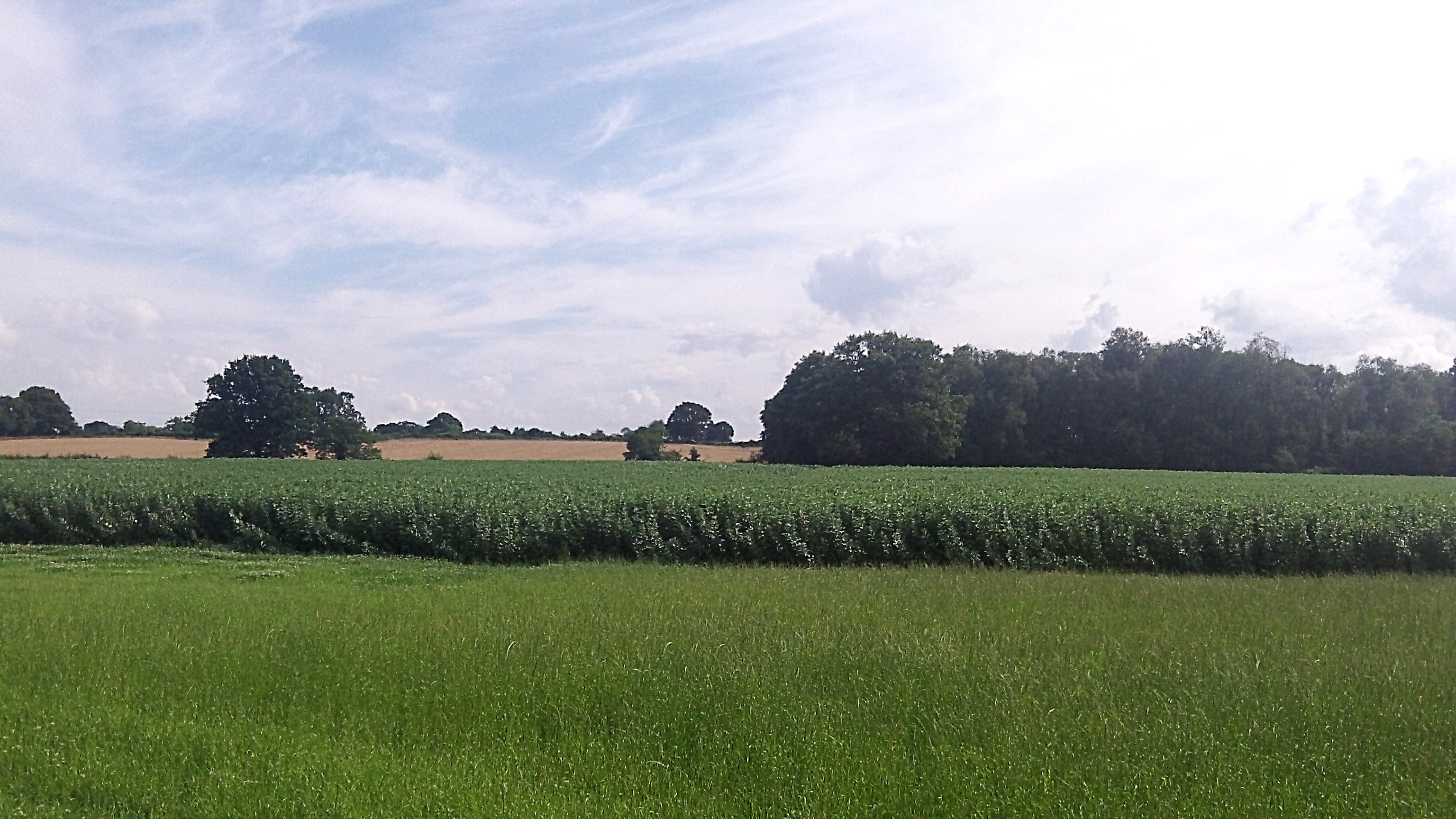 |
Bean crops near Meriden |
Benton Green Lane was reached eventually, via directions that had ceased to correspond to reality several fields back. I flopped onto a grass verge in front of a large detached house with a For Sale sign on the gate, wrung the last few drops from my water reservoir — enough to moisten the lips, no more — and rested in the sign's shade for a while.
Then, rounding a corner, a sign on the roadside twenty yards ahead offered hope - a garden centre. Garden centres have fridges full of cola and orange pop and — crucially — water. I picked up the pace. I sorted through my pockets for change. I calculated how many bottles I could carry.
The gate was locked.
It had closed ten minutes before I arrived.
I’ve bean to Meriden ...
The stile, when I found it, led into fields for the final stretch. I recorded a video that was honest about the state of things — the heat, the thirst, the accumulation of miles, the particular fatigue that comes when the body has been asking for water for too long and receiving none. I mentioned that there were rather a lot of fields on the Millennium Way. This is true. Ninety percent of the route is field walking, which can produce a certain monotony if the weather, or one's hydration levels, are not cooperating. Had I been less parched I would have delivered a rosier assessment. As it was I felt the record deserved an honest entry.
I walked a short section of Back Lane and then a caravan storage park at Flints Green provided a diversion of sorts — rows of deserted caravans in the afternoon heat, something metallic clanging rhythmically in the breeze, the specific atmosphere of a place where things are stored rather than used. Security appeared to be a theoretical concept. I walked in through the front, past some expensive rolling stock, and out through a gate at the back without encountering anyone.
Then wheat fields, and ahead of them the green line of Millison’s Wood at Meriden. The end visible. I walked toward it with the gratitude of someone who has been walking for a long time and can now count the remaining distance in minutes. At the wood's edge I stopped. The map showed my path clearly. What the map did not show was the solid green wall of bean crop planted directly across it — chest high, densely packed, the marker post just visible beyond it as a yellow smudge under the trees.
With a mixture of amusement and mild despair I went in. Every step snagged a root or a stem. I made involuntary noises. I was comprehensively smeared with green sap. The beans reached for my ankles with a thoroughness suggesting they had opinions about trespassers. I emerged on the other side with mottled green trousers carrying the distinct scent of freshly crushed vegetation.

The pub was open. Early drinkers sat in the sunshine with cold beer. Thirty yards away. I had walked seventy-two fields to get here and my mouth contained approximately zero moisture.
From the car I retrieved a bottle of Lucozade Sport. Raspberry flavour. My least favourite. Disgustingly warm. It tasted like the finest thing I had ever consumed and was gone in four swallows.
I sat and regarded the pub.
Then I drove home.
For a full profile of the route (PDF format) click here
See Route on ......
|
|
|
|
|
 Prev
Next
Prev
Next
